
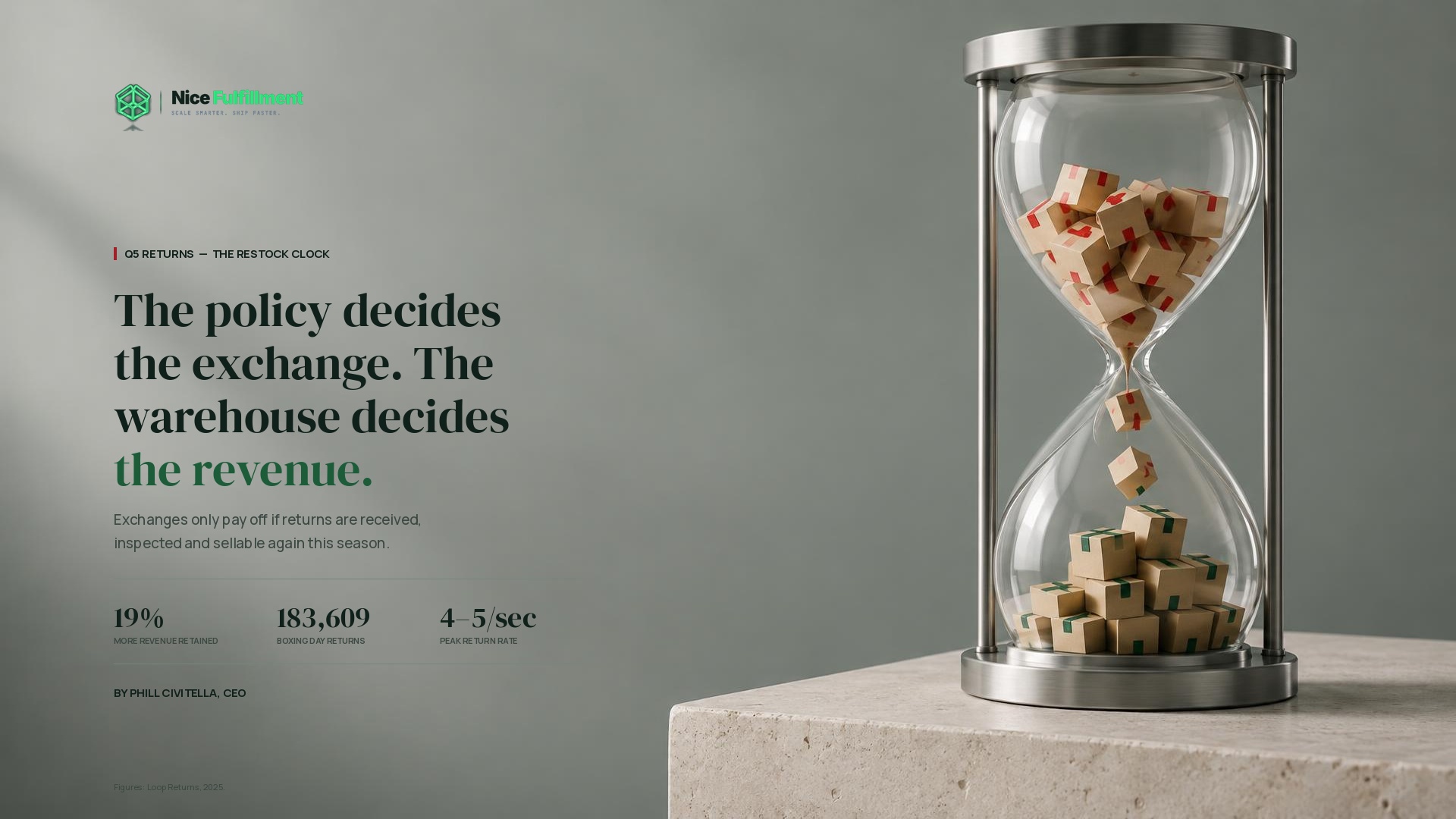
New data from Loop Returns shows exchange-first policies retain about 19% more revenue after returns than refund-first ones, a real swing worth over $100,000 on $1M in returned goods in their published example. That's a genuine, useful finding. What it doesn't capture is the operational half of the equation: an exchange only pays off if the returned item gets received, inspected and back on the virtual shelf fast enough to be sold again this season, not next. The software decides the policy. The warehouse decides whether the policy's upside actually shows up on the P&L.
- Q5 — the ecommerce industry's informal name for the holiday returns season, running roughly from December 26 through late January.
- The restock clock — the time between a returned item arriving at a warehouse and that item becoming sellable again, the operational factor that decides whether an exchange-first returns policy's revenue advantage actually shows up on the P&L.
NRF projects a record U.S. holiday season this year, with November and December retail sales expected to climb 4.2% to $1.013 trillion. Every one of those dollars eventually produces a return, and Q5 is when that wave actually lands on a warehouse floor.
Loop Returns, which processes returns for more than 5,000 merchants, reported that Boxing Day 2025 was its highest-volume return day ever: 183,609 returns in a single day, up about 15% from the year before, averaging roughly 7,650 returns an hour with peaks of 4 to 5 returns every second. Eight of Loop's ten highest-volume return days on record happened in 2025.
That volume is coming again this year, bigger. The question worth asking in mid-November, before it hits, isn't just "what's our return policy." It's whether your operation can actually execute that policy fast enough to matter.

What Does the Data Actually Say About Exchange-First vs. Refund-First?
Merchants who default to offering an exchange before a refund kept about 19% more return-driven revenue than the network average, according to Loop.
In Loop's own BFCM revenue analysis, the gap shows up clearly in a worked example on $1M in BFCM sales:
| Refund-first | Exchange-first | |
|---|---|---|
| Returned revenue | $180,000 | $50,400 |
| Revenue kept | $820,000 | $949,600 |
| Advantage | $0 | +$129,600 |
The exchange-first side assumes up to 72% of returned revenue is retained, Loop's best-case figure. The mechanics behind it line up with how shoppers actually behave once an exchange is on the table: exchanges convert at 24.5% versus 8.2% for store credit, and the average exchange carries a $22 upsell on top. Loop also reported that turning on an instant- exchange option at checkout coincided with a 4.2-point lift in January customer retention, while turning it off coincided with a 4.1-point drop.
That's a real, specific, well-documented advantage. It's also, on its own, an incomplete picture of what actually determines whether a brand captures it.
What Does the Exchange-First Data Leave Out?
We call this gap the restock clock, the time between a returned item arriving at a warehouse and that same item being sellable again, and it decides how much of the exchange-first advantage a brand actually keeps.
Here's the mechanic. An exchange only generates the upside Loop measured if the returned item (or the inventory used to fulfill the replacement) is actually available to sell. If a return sits unprocessed on a dock for a week before it's inspected, logged and put back into sellable inventory, that's a week where it can't be resold, can't back-fill the next exchange request, and effectively turns back into dead stock sitting exactly where a refunded item would have. A fast restock clock is what converts "customer chose an exchange" into "that exchange actually paid for itself again." A slow one quietly erodes the same advantage the policy was supposed to capture.
It's worth being honest about what Loop's own data does and doesn't show here. Their regional breakdown found AU/NZ retaining 52% of return value, the US 38%, and the UK only 14%, and the article attributes that gap to market and policy differences, not operational speed. We're not claiming warehouse restock time explains that specific gap, Loop didn't measure it that way. What we are saying is that restock speed is the variable sitting underneath every one of those regional numbers that a checkout-side returns platform has no visibility into and no control over, because it lives entirely inside the warehouse.
Does Return Fraud Actually Matter This Season?
Yes, and catching it is a shared job between the returns platform and whoever physically opens the box.
Loop's data from last season found that 28% of returns over $800 carried fraud signals, and its fraud detection tools flagged and prevented a reported $552K to $994K in fraud between November 27 and January 1 alone. Across its full network, Loop has flagged $250M in refund value and identified more than 394,000 high-risk customers.
Software can flag a suspicious pattern before a label even gets issued. It can't tell you whether the box that actually arrives matches what was supposed to be inside it, whether the item shows wear inconsistent with the stated reason, or whether a "wrong item" claim is accurate. That part happens at receiving, by a person following a written inspection process, which is exactly the kind of scan- based, SOP-driven step that either closes the loop on a fraud flag or lets it slip through anyway. The two systems work best stacked, not as a substitute for each other.

What Should a Brand Actually Check Before Q5 Hits?
Whether your warehouse can keep up with the returns policy your checkout is about to promise, not just whether the policy itself sounds good.
A few concrete things follow from the data above:
- Know your restock clock, in days, not vibes. Ask your 3PL how long it actually takes a returned item to go from dock to sellable inventory during peak volume, not during a quiet week in July. If nobody can give you a number, that's the number.
- Make returned inventory visible the moment it's back, not after a batch job runs overnight. Real-time inventory visibility matters as much for inbound returns as it does for outbound orders. An exchange that's technically processed but invisible in your stock count for two days is still losing you sales on that SKU.
- Treat receiving as a fraud-detection step, not just a put-away step. A scan-based intake process that checks condition, contents and reason-for-return against what the platform flagged closes the loop that software alone can't.
- Have someone who can actually answer for returns volume in real time. When Q5 hits, a dedicated account manager who already knows your SKUs can flag a restock bottleneck before it costs you a week of lost resale, instead of after.
None of this replaces a good returns policy. It's what determines whether that policy's numbers, the ones Loop just published, actually show up in your own P&L.
"Everyone wants to talk about the return policy because it's the part customers see. Almost nobody asks how fast the warehouse turns a returned box back into sellable inventory, and that's the part that actually decides whether the policy pays for itself. We've watched good exchange strategies get quietly erased by a slow restock clock more times than I can count."
Loop's data makes a strong case for exchange-first policies, and brands should take it seriously. Just don't stop at the policy. The restock clock is the part of this equation that lives entirely in fulfillment, and it's the part most of the current conversation about holiday returns isn't measuring at all.
See how Nice Fulfillment handles returns processing and restock speed, or talk to us before Q5 hits.
Phill Civitella is CEO of Nice Fulfillment, a bootstrapped, tech-first 3PL operating from Charleston, SC and Salt Lake City, UT. He started in fulfillment in 2009 as a part-time warehouse associate and has spent 18 years building fulfillment operations from the ground up.