
The Nice Blog · Inventory Operations
Why Your 3PL's Inventory Blind Spot Is Costing You Six Figures a Year
Most ecommerce brands do not lose money to a shipping failure at their 3PL. They lose it to a visibility failure — and it is one of the most expensive blind spots a growing brand can carry without knowing it.
The founder story
The call nobody wants to get.
A founder running a collagen and bone broth supplement brand gets a message from her 3PL: six pallets of her bestselling SKU are 45 days from their sell-by date. Nobody flagged it when the lot came in. Nobody flagged it at the 90-day mark either. The first anyone heard about it was the week it turned from inventory into a write-off.
That call happens more often than most ecommerce brands admit out loud. It is rarely a shipping failure. It is a 3PL inventory visibility failure — and it is one of the most expensive blind spots a growing brand can carry without knowing it.
The four cost paths
Four ways an inventory blind spot bleeds you — none of them on the invoice.
Real-time inventory tracking at your 3PL is the difference between writing off six pallets and selling them. These are the four paths cash disappears down.
Cost path 01
Expired-lot write-offs.
Product that ages past its sell-by date while nobody is watching turns from inventory into a loss, usually discovered during a routine count rather than caught early enough to sell through, discount, or redirect.
Cost path 02
Compliance and recall exposure.
Supplement and cosmetics brands operate under FDA and retailer-specific labeling rules. A lot you cannot trace quickly turns a recall that should take hours into one that takes days — and in a real recall, days are the difference between a manageable event and a brand crisis.
Cost path 03
Stockouts on your bestsellers.
The same blind spot that hides an expiring lot also hides a reorder point you are about to blow through. Brands that cannot see their real-time stock position tend to find out they are out of their top SKU the same week a retailer or ad campaign sends their biggest order volume of the quarter.
Cost path 04
Retailer and marketplace delisting risk.
Amazon and major retail partners track in-stock rate and lot compliance closely. A repeated stockout or an expired-product complaint does not just cost one order — it puts the account itself at risk.
The stale-data problem
Why a spreadsheet (or a once-a-day portal) cannot catch this.
Most brands do not lack data. They lack current data. That is what turns an expiring lot into a write-off and a depleting reorder point into a stockout.
A cycle count tells you what was true last month. A spreadsheet your 3PL emails over is out of date the moment it lands in your inbox. Even a 3PL portal that only refreshes overnight is still showing you yesterday's warehouse — and an expiring lot or a depleting reorder point does not wait for your next login.
The information usually exists somewhere. The problem is that it lives in three disconnected places, updates on its own schedule, and reaches you only after someone remembers to go look for it.
Real-time inventory tracking from a 3PL does not start with a better-looking report. It starts with a different operating model — and that is what closes the loops above.
The operating model
What real-time inventory visibility at a 3PL actually looks like.
Real visibility is not a nicer dashboard. It is a different operating model built on lot-level data, scan-based ops, and one source of truth.
Real 3PL inventory visibility is not a nicer-looking report. It is a different operating model, built on a few things:
- Live lot and expiration data tied to every unit in the warehouse, not a count taken once a month.
- Lot and expiration tracking that triggers automated alerts at the reorder point you set, not a manual check someone has to remember to run.
- 100% scan-based warehouse operations, so what the system shows is what is actually on the shelf, not what was true at the last manual count.
- One source of truth, not three. Your WMS, your 3PL's portal, and your own spreadsheet should all be the same number, updated the same moment something changes.
The vetting checklist
The questions to ask any 3PL before you sign.
If you are evaluating a 3PL — or wondering whether your current one has this covered — ask directly. Five questions, in this order.
- 01
Can I see my lot numbers and expiration dates in real time, or only when I request a report?
- 02
What happens automatically when a lot crosses a threshold I set, like 60 or 90 days from expiration?
- 03
Is your warehouse 100% scan-based, or do counts depend on someone writing numbers on a clipboard?
- 04
If I needed to trace and pull a specific lot today for a recall, how long would that actually take?
- 05
Do I get one dashboard, or do I have to reconcile your system against my own spreadsheet?
If the honest answer to more than one of these is "we will get back to you," the blind spot already exists. It is just a matter of when it gets expensive.
The fix
How Nice Fulfillment closes this gap — and what we are launching November 1.
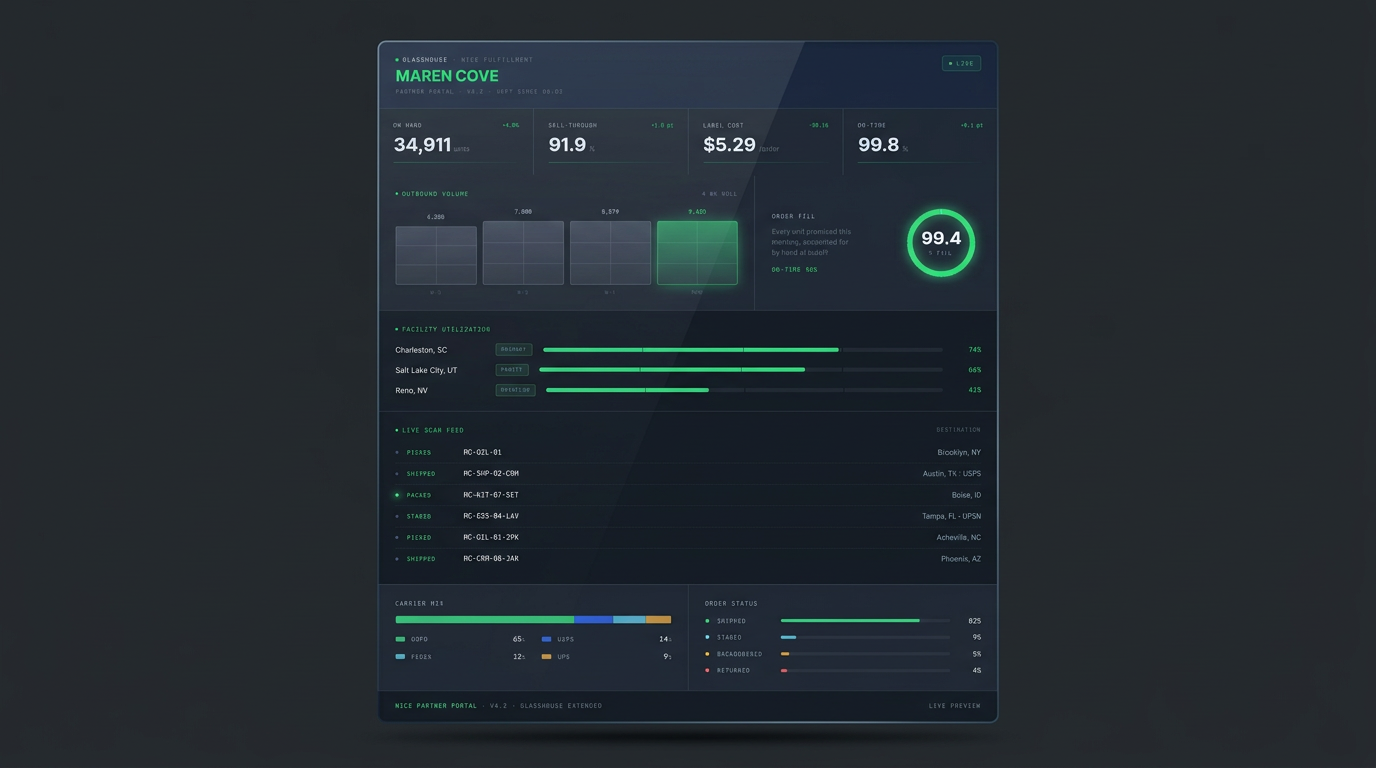
Glasshouse is the live dashboard that turns the questions above from a guessing game into something you can check in the time it takes to open a browser tab.
This is the exact problem we built Nice Fulfillment around solving for consumables, supplement, cosmetics, pet care and wellness brands running through our Charleston and Salt Lake City hubs. Our warehouse operations are 100% scan-based, and ShipHero runs as our warehouse management system, so what shows up in the system reflects what is actually happening on the floor, not a nightly reconciliation.
On November 1, we are launching Glasshouse, a live dashboard that shows your lots, expiration dates and reorder points in real time, pulled directly from the warehouse floor instead of a report someone has to build for you. It turns the questions above from a guessing game into something you can check in the time it takes to open a browser tab.
None of this matters if the orders do not actually ship. We run at 99.8% on-time, so the visibility you get is paired with fulfillment you can rely on.
Ready to see what you are missing?
That founder's six pallets did not have to become a write-off.
If you run a consumables, supplement, cosmetics, pet care or wellness brand and you cannot answer the five questions above with confidence, we'd like to show you what Glasshouse looks like before your inventory becomes a story like hers.
That founder's six pallets did not have to become a write-off. If you run a 3PL for supplement brands with high-compliance SKUs, the cost of a blind spot compounds every quarter — in expired-lot write-offs, surprise stockouts, rush reorders, and the retailer in-stock penalties that quietly become account-review triggers.
3PL inventory visibility is the lever. Book a call with our team to see your lots, expiration dates and reorder points the way they should look: live, not last month's.
Author
Phill Civitella
CEO, Nice Fulfillment
Last updated October 26, 2026
Frequently asked
The questions brands ask once an inventory blind spot starts showing up on the P&L.
01What is inventory lot and expiration tracking in 3PL fulfillment?
It is the practice of tracking individual batches, or lots, of inventory by their expiration or best-by date as they move through a warehouse, so a brand always knows what is aging out and when, rather than finding out during a routine count.
02Why do ecommerce brands write off expired inventory?
Most write-offs happen because nobody is notified early enough. The inventory sits in a system that updates periodically rather than in real time, so an expiring lot goes unnoticed until it is already past the point of being sellable.
03How much can poor inventory visibility cost a growing brand?
The exact figure depends on SKU count, velocity, and category, but the pattern is consistent: brands lose money to a combination of write-offs, rush reorders after unexpected stockouts, and retailer penalties for low in-stock rates, often without a single line item that explains why.
04What should I ask a 3PL about inventory visibility before signing a contract?
Ask whether you can see lot numbers and expiration dates live, whether reorder-point alerts are automatic, whether the warehouse is fully scan-based, and whether you would be working from one dashboard or reconciling your own spreadsheet against theirs.
05What is Glasshouse?
Glasshouse is Nice Fulfillment's real-time fulfillment visibility dashboard, launching November 1, 2026. It shows lots, expiration dates and reorder points live, pulled directly from the warehouse floor.
06Is real-time inventory visibility only important for supplement brands?
No. It matters most wherever expiration dates, lot compliance, or fast-moving SKUs are involved, which includes supplements, cosmetics, pet care and wellness brands, but the underlying problem of stale data hiding a growing risk affects any brand managing inventory through a 3PL.