
It's the run-up to BFCM, and every brand in your inbox is shouting “free shipping.” What you don't know is what it's going to cost you once orders start pouring in, and whether “free shipping over $50” is a growth lever or a slow leak in your margin.
The fix is to treat your threshold as math first and marketing second. Start from your average order value and what you pay per shipping label, then set the threshold high enough that the extra items in the cart cover the label. For most brands, that lands somewhere above current AOV — close enough that shoppers can reach it with a small add-on.
Holiday shoppers compare shipping costs gift by gift.
Free shipping matters more in Q4 because holiday shoppers are often buying small gifts from several brands at once, and a shipping fee is the easiest line item to compare across tabs.
Among shoppers who left a checkout for a reason other than “just browsing,” Baymard Institute found that 40% cited extra costs being too high (shipping, tax and fees). During the holidays, a shopper who bails on your cart has plenty of other gift options a click away.
Brands often treat free shipping as a marketing line, but every free label is a cost that moves from the customer's side of the receipt to yours and comes out of product margin. So the threshold's job is to make sure each qualifying order carries enough margin to pay for it. That's a calculation you can run before you announce anything.
How do you calculate a free shipping threshold?.
You need three numbers: your average order value (AOV), your average label cost per order, and your gross margin on product. From there, the process looks like this:
- Find your real AOV from the last 60 to 90 days. Pull last year's holiday AOV if you have it — gift orders often skew smaller or larger than your baseline.
- Find what you pay per label from carrier invoices, not the shipping rate you charge customers.
- Calculate the order value needed to cover the label: divide label cost by your gross margin.
- Set the threshold near AOV plus that number. Round to something clean, and sanity-check that it sits within reach of a typical cart (often 15% to 30% above AOV).
A worked example
Numbers below are illustrative, not benchmarks. Substitute your own AOV, label cost and margin.
| Input | Example value |
|---|---|
| Average order value | $58.00 |
| Average label cost | $9.50 |
| Gross margin on product | 55% |
| Extra order value to cover the label ($9.50 ÷ 0.55) | $17.27 |
| Suggested threshold ($58 + $17.27, rounded) | $75 |
At $75, product margin is $41.25. Subtract the $9.50 label and the order contributes $31.75 — nearly identical to the $31.90 in product margin your $58 order earns today. The free-shipping order is about as profitable as a typical order, which is the point.
Peak surcharges are easy to leave out of this math. Carriers add holiday demand surcharges from late fall into the new year. For 2026, UPS applies them to Ground Residential and Ground Saver packages from October 25, 2026 through January 16, 2027, with the highest rates between November 22 and December 26. If your label rises to $10.25 in December, the same math pushes your threshold closer to $77. Since label cost drives the whole calculation, the next question is what drives label cost.
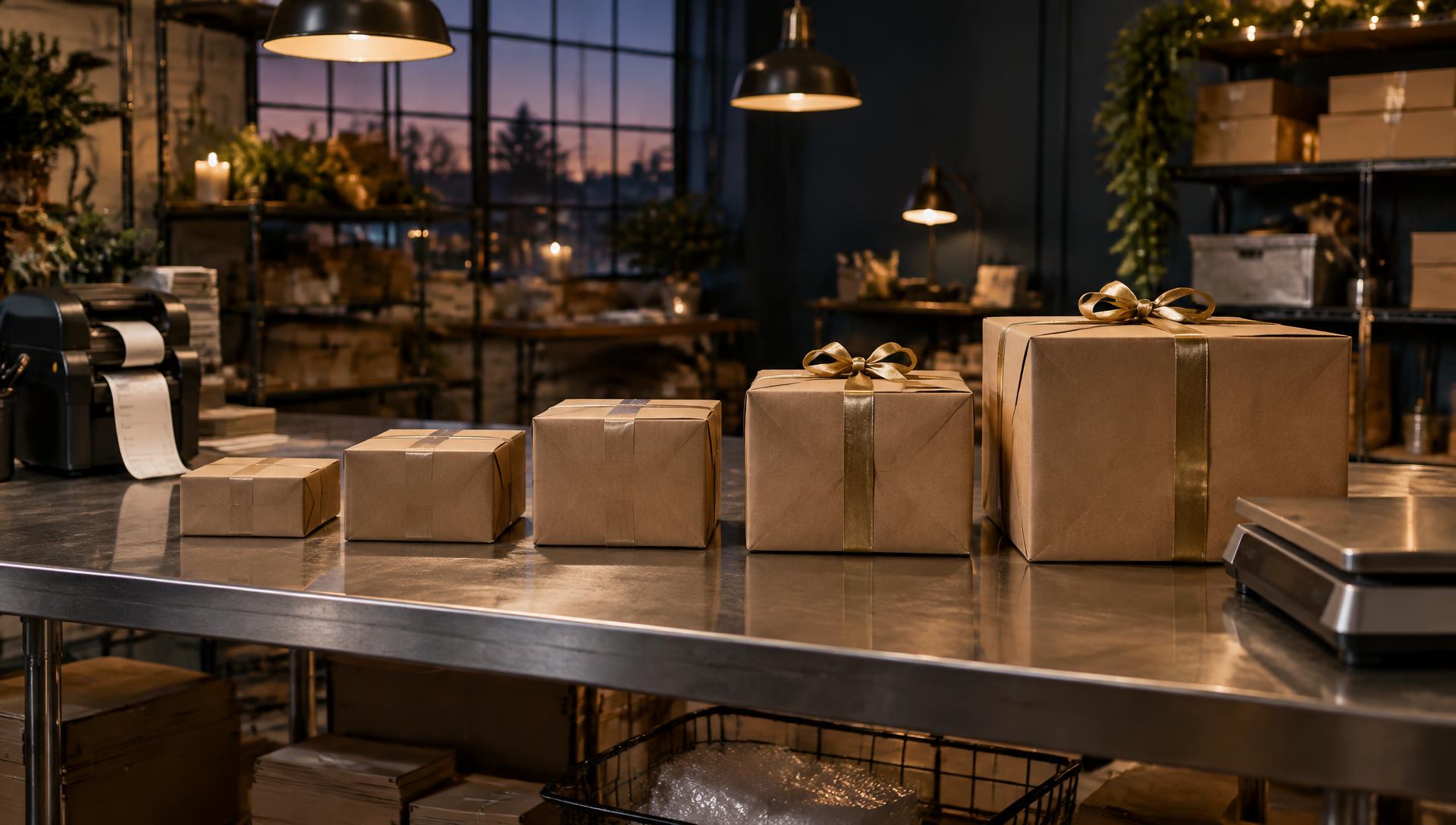
What changes between $58 and $75 orders
At a 55% gross margin, a $9.50 label asks for roughly $17 in added cart value to cover it. In practice that's one additional product — the kind the shopper would have considered anyway.
Shorter shipping zones make free shipping cheaper to offer.
Carriers price ground shipping by zone, a measure of the distance between where a package starts and where it lands. For most domestic shipments, zones run from 1 (closest) up to 8 (farthest), as shown in USPS's published rate tables. The farther a package travels, the more it tends to cost to ship, and the longer it takes to arrive.
This matters for your threshold because your average label cost reflects your zone mix. A brand shipping everything from a single warehouse on one coast will send a large share of orders into high zones. A brand shipping from an East Coast and a West Coast warehouse can route each order to the closer building, pulling its average zone down.
Why zone mix is a margin lever
Two brands at the same AOV and margin can land at different thresholds based purely on where they ship from.
| Setup | Average zone | Avg. label cost | Threshold |
|---|---|---|---|
| One warehouse | ~5 | $9.50 | $75 |
| East and West Coast warehouses | ~3 | $7.75 | $72 |
That $1.75 per label gives you two choices — lower the threshold so more shoppers qualify, or keep it at $75 and hold onto the extra margin on every order. Read the comparison in detail at the bi-coastal network page.
Comparing rates across carriers for each shipment can trim label costs further, since the cheapest carrier for a given package and zone isn't always the same one. Package size can undo those savings — dimensional weight pricing charges by box size as well as weight, so an oversized box can cost more than a shorter trip saves. Once label cost is under control, the next question is whether free shipping is the right offer at all. See right-sizing packaging before peak for the box-side of the math.
When does free shipping beat a percentage discount?.
Free shipping costs a fixed dollar amount per order, while a percentage discount grows with the cart. That makes free shipping the cheaper offer past a certain order size. With a $9.50 label, free shipping costs less than 10% off once orders pass $95, and less than 15% off once they pass about $63.
| Offer | Cost on a $75 order | Cost on a $120 order |
|---|---|---|
| Free shipping | $9.50 (12.7%) | $9.50 (7.9%) |
| 10% off | $7.50 | $12.00 |
| 15% off | $11.25 | $18.00 |

Reading the table as a margin lever
Free shipping flips from the more expensive offer to the cheaper one as carts grow past $63 — and keeps widening that gap the higher AOV climbs.
Free shipping tends to win when your AOV is mid-to-high, your products are light, and the threshold gives shoppers a reason to add an item. A percentage discount can make more sense when:
- Your AOV is low and the label would eat a large share of each order.
- Your products are heavy or bulky, so labels cost more than a modest discount.
- You're clearing specific inventory and want to move units more than lift cart size.
A sitewide percentage discount also cuts margin on every item in the cart, including bestsellers that would have sold at full price anyway. Free shipping leaves your product pricing intact. Whichever direction looks right on paper, the clearest way to know is to test it with real shoppers before BFCM.
How do you test a free shipping threshold before BFCM?.
The weeks before BFCM are the cleanest window to test, since traffic is building but holiday promotions haven't scrambled your data yet. If that window is short, test what you can now and refine for December. Simple approaches include:
Sequential tests
Run one threshold for a week, then a second for the next week, and compare.
Split tests
Use your ecommerce platform or a shipping app to show different thresholds to different visitors, if your setup supports it.
Track four numbers for each version: AOV, conversion rate, the share of orders landing just above the threshold, and contribution per order after shipping. A threshold that raises AOV but drops conversion sharply may be leaving holiday revenue on the table.
Keep each test running at least a full week so you capture weekday and weekend behavior, and avoid overlapping it with other promotions. Then lock your number before BFCM and decide in advance whether you'll adjust it if surcharges rise in late November. This piece of the planning fits squarely inside BFCM inventory forecasting.
The right free shipping threshold starts with what each label costs.
A free shipping threshold works when it's built from your real numbers — your AOV, your margin, and what you pay to get each box out the door. Set it from those, test it before BFCM, and it becomes one of the few holiday offers that pays for itself. Of everything in the calculation, label cost is the number that moves most with how and where you ship, and it decides how generous you can afford to be.
That's where your fulfillment setup comes in. Shipping distance and carrier choice set your average label cost long before a shopper reaches checkout. At Nice Fulfillment, our bi-coastal network ships orders from the warehouse closer to each customer, lowering the average zone, and real-time rate shopping picks the most cost-effective carrier for every package. The result is a lower cost per label, which gives you more room to offer free shipping this season without giving up margin to do it.
Talk to our team
Want a second set of eyes on your threshold before BFCM?.
Send us your average label cost, AOV and margin, and we'll walk through a threshold calculation tailored to your catalog.
About the author
Sophie Hilbourn — Content Lead, Nice Fulfillment
Sophie writes the operational guides Nice Fulfillment ships to its customers — the kind that walk through real numbers, real carrier rules, and the tradeoffs brands actually face when volume climbs. Reach her at sophie@nicefulfillment.co.