
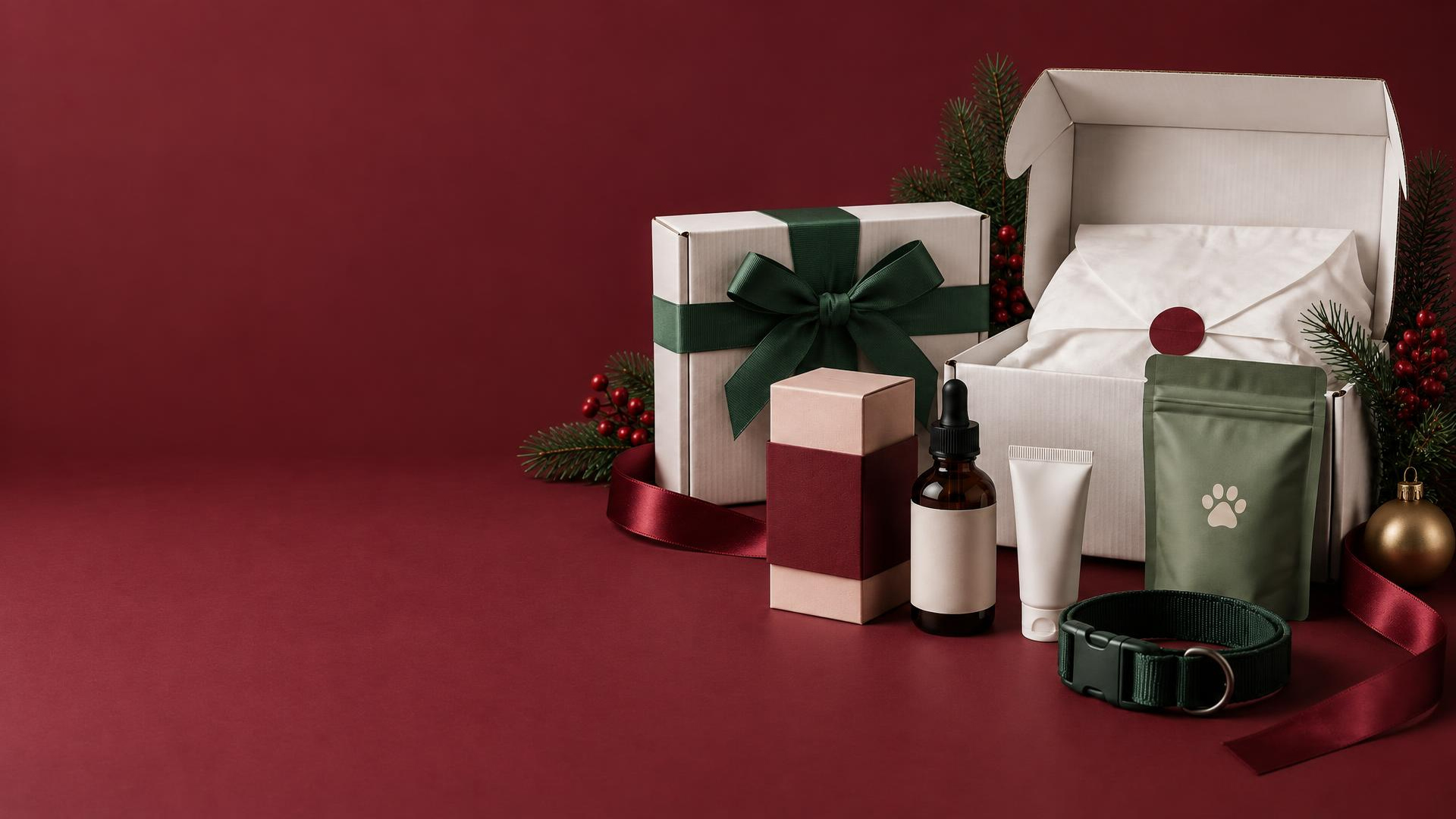
Your holiday promos are scheduled, and now someone on the team is asking whether the packaging should look more festive this year. Maybe a competitor's unboxing video keeps showing up in your feed, and custom boxes are starting to sound like a good idea. Is there still time to get them, and would they be worth it?
For most beauty and pet brands, the upgrades worth making this year are the inexpensive ones: branded tissue, a sticker seal, a seasonal insert card and protection that gets the product there intact. Fully custom printed boxes can make a strong impression, but they cost more, take longer to source and, from late October, are better planned for next year.
Holiday packaging is one of the few places a small brand's unboxing can compete with a much bigger one, and one of the easiest places to create a December bottleneck. This guide breaks down:
- What customers notice when they open a holiday order
- How tissue, stickers and inserts compare to custom boxes
- What you can still source in time this season
- How to add special packaging without slowing pack times
- How to plan quantities and use up leftovers
What do customers notice when they open a holiday order?
Customers tend to notice three things: whether opening the box feels like a moment, whether the order is ready to give as a gift and whether everything arrived in one piece.
The unboxing moment happens in the first few seconds after the tape is cut. Tissue, a sticker holding it closed and a card on top signal that a person packed the order with care. It's also the part that ends up on social media. The outside of the box has a shipping label on it and spent three days in a truck; the inside is what gets filmed.
Gift-ready presentation matters more in Q4, when many orders are gifts. A packing slip showing prices or a product rattling loose in a mailer makes the buyer do extra work before handing it over. A price-free slip and an optional gift note remove that step.
Damage-free arrival is the one brands most often underinvest in. It's easy to spend on presentation while keeping the same protection as the rest of the year, even as carrier networks run at peak volume. A cracked serum bottle or a punctured bag of dog treats in a beautiful box is still a broken order, plus a replacement shipment and possibly a bad review. For beauty brands, that means securing glass, pumps and liquids. For pet brands, it means accounting for heavy items that crush whatever is packed next to them.
Since most of what customers notice happens inside the box, the next question is how much the box itself needs to change.
How do tissue, stickers and inserts compare to a custom box?
Interior upgrades change what customers see when they open the box, which is where most of the impression forms, and they work with the stock boxes you already use. A custom printed mailer changes the outside, typically comes with minimum order quantities and a higher unit cost, and adds a new packaging SKU to receive, store and manage.
Box size is where custom holiday packaging catches brands off guard. A box designed around your hero product may not fit this season's bundles and gift sets, so packers add void fill or reach for a bigger box. Carriers bill many parcels on dimensional weight — a price based on the package's size as well as its actual weight — so a larger festive box can raise shipping cost on every order it touches. USPS publishes a shipping services overview that explains how dimensional weight feeds into retail rates across Priority Mail and Ground Advantage.
The insert card does the most for repeat purchases: a January-only discount code gives a gift recipient a reason to come back to a brand they didn't choose themselves. Sourcing speed is the other reason interior upgrades win this year.
What holiday packaging can you still source from late October?
Stock materials with simple branding are still realistic from late October; fully custom printed boxes generally aren't.
Custom boxes pass through artwork approval, proofing rounds, a production queue at suppliers in their own busiest season, freight and warehouse receiving before a single order can ship in one. Custom printed mailers commonly take several weeks from approved proof to delivery, and any revision restarts part of that clock.
Delivery also isn't the same as ready to use. Materials have to be counted, put away and added to packing instructions. Brands that use a warehouse or 3PL need to ship the packaging there and allow time for it to be received before the first order goes out. With Black Friday on November 27 and Cyber Monday on November 30 this year, packaging that lands in early December misses the season's biggest order wave.
Still realistic to source from late October:
- Stock tissue in a brand color or seasonal pattern.
- Digitally printed stickers with the brand mark or short seasonal line.
- Insert cards from a local or online digital printer.
- Stock gift boxes or bags for bundles — same lead-time profile as tissue.
Whatever you choose also has to fit the packing workflow, which is where seasonal upgrades tend to cost more than their unit price.
How do you add holiday packaging without slowing pack time?
Every extra packing step adds seconds per order, and at peak volume those seconds turn into hours of labor.
Example
If the interior upgrades add 15 seconds per order, 2,000 orders a day adds a little over 8 hours of packing. That's roughly one full shift, every day of peak.
Inconsistency slows packing as much as the steps themselves. When packers decide order by order who gets which upgrade, they hesitate and mistakes rise: a gift note goes missing, or a wholesale order gets holiday tissue.
Automation rules take that decision off the packing table. Most warehouse and order management systems can tag orders by contents or order type and show the right packing instructions on screen. For example, gift-flagged orders get the gift-ready setup, bundle SKUs get the insert card, and subscription and wholesale orders stay standard. Pre-folding tissue or pre-stuffing card envelopes in early November also moves work out of the busiest hours. The same logic that drives our BFCM order automation rules applies to gift-tagged orders year-round.
How much holiday packaging should you order, and what do you do with leftovers?
Buy enough for the orders your rules will apply each upgrade to, plus a modest buffer, and choose designs that can outlive December.
Start with last year's November and December volume, adjust for this year's forecast and apply it only to eligible orders. If gift orders were a fraction of last season's volume, there's no reason to buy tissue for every order. The 2025-to-2026 peak data breakdown is a starting baseline; your own prior-year Q4 numbers are better.
Date-specific designs are how seasonal materials become dead stock. Anything printed with the year or December-only artwork sits on a shelf after the holidays, taking up storage you may be paying for. Winter-neutral designs or brand colors keep their value past New Year's Day and can carry over to:
- Valentine's Day orders, especially beauty gift sets.
- Bundles and gift sets, including new-pet kits and reissue SKUs.
- Loyalty and VIP orders, as a thank-you to repeat customers.
- Creator and PR mailers, where the unboxing will be on camera.
The holiday packaging worth paying for is the kind your packing line can keep up with
The upgrades that drive repeat purchases and social shares are the ones customers see when they open the box, and none of them count if the product arrives damaged. They cost a fraction of a custom box, can still be sourced this season and are easy to apply consistently with the right packing rules. A stock box with a well-packed interior that arrives on time and in one piece will earn more repeat orders than a custom box that shows up late or crushed.
The harder part is everything around the materials: deciding which orders get which upgrade, setting rules so packers aren't making calls on the fly and keeping pack times fast while volume climbs. That's the work Nice Fulfillment takes on for beauty and pet brands, from kitting and assembly through gift-ready packing that holds up through peak.
See also: cosmetic and beauty fulfillment, pet care fulfillment, the ecommerce order insert guide, and how our on-site account managers run seasonal floors.